Temporary relocation is not just about where you sleep
Many people choose relocation accommodation using the same logic they would use for a city break: close to the office, simple, efficient. The problem appears after a few days, when you realise you’re no longer a tourist - you actually live there. You need quiet for work, but also life after office hours, a place where you feel comfortable, not just “lodged”.
In Bucharest, the differences between neighbourhoods become obvious the moment you close your laptop. Some areas stay lively, with restaurants, cafés and people on the street, while others empty out completely. If you’re staying for 30, 45 or 60 days, these small details become surprisingly essential for your day-to-day wellbeing.
After a week, you’re no longer a tourist - and the apartment starts to matter more than the office location.
Efficient for work, less so for living
Business areas: Neighbourhoods such as Pipera, Militari or Timpuri Noi are excellent for work. Modern buildings, well-organised offices, decent transport access and everything you’d expect from corporate infrastructure. Until 6 p.m., everything runs beautifully.
After work: Once the workday ends, though, the atmosphere changes noticeably. Many of these areas become quiet to the point of feeling empty, and the options for going out for dinner or taking a walk are limited. For someone staying for a few months, that gets repetitive rather quickly.
Transport: Yes, they are well connected by metro, and Bucharest’s metro is unquestionably the fastest way to get around. But relying on it every day just to “get into town” after work is not exactly the most pleasant long-term routine.
The office district is excellent between 09:00 and 18:00. The problem is that the day has more hours than that.
Real urban life, not just proximity
Access and connections: The University Square area is one of the city’s best-connected points. You have quick access to the north (Aviatorilor, Herăstrău), west (Gara de Nord), east (Piața Muncii) and south (Unirii), whether on foot, by metro or by surface transport.
After-work life: Unlike office zones, the city centre stays active after 6 p.m. Restaurants remain open, cafés are busy, and a simple walk doesn’t require planning. You don’t need to “go somewhere” to feel the city - it’s already around you.
Balance: For a relocation of a month or more, the centre offers that rare balance: you can work efficiently during the day and naturally switch off in the evening, without having to change areas or rely on transport for every little thing.
The centre doesn’t just give you access to the city - it gives you the feeling that you’re part of it.
Real criteria, not just pretty pictures
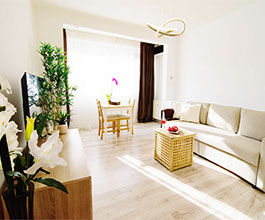
Enough space: A two-bedroom apartment or a three-room flat is ideal, especially if family visits are possible or if you want to clearly separate your work zone from your rest zone. Studios look good in photos, but after two weeks they start to feel limiting.
Work-friendly: A “good for work” apartment means high-speed internet, a real desk (not just the kitchen table) and enough natural light. Small details, but the kind that make the difference between a productive day and a frustrating one.
Daily functionality: A washing machine becomes essential after the first week. A properly equipped kitchen, storage space and a decent living room all help create the feeling that you actually live there, rather than just pass through the space.
Flexibility: For stays of 30–60 days, you need a place that lets you build a routine: work, cook occasionally, have a friend over without feeling like you’re squeezing them into a corner of the room.
After 30 days, you’re no longer looking for accommodation - you’re looking for a place where you can function normally.
Looks great in photos vs. works well in real life
The ideal relocation apartment is not the one that looks best on Instagram, but the one that works effortlessly in everyday life. A perfect décor matters less than whether you have somewhere comfortable to work, whether you can do laundry without a strategic plan and whether you have enough space to avoid feeling like you’re living in an extended hotel room.
Routine becomes the real test: in the morning you start work without improvisation, in the evening you can go for a walk or dinner without crossing half the city, and at weekends you don’t feel the need to “escape” from the neighbourhood you live in. If those things feel easy, you’ve made the right choice.
The right choice doesn’t show in photos - it shows every day.
The centre as a balanced relocation base
For a consultant seconded to Bucharest, the centre - especially the University Square area - remains the most balanced choice. It is not just a place to stay, but a base from which you can work, live and function without major compromises. You get access, city life and the flexibility you need for the medium term.
And after a few weeks, you’ll realise the real difference was not the distance to the office, but how well you managed to build your life around the apartment you chose.
Alia Accommodation Bucharest offers a wide range of serviced apartments in Bucharest and short-term accommodation in central Bucharest, suitable for medium- or long-term stays.